
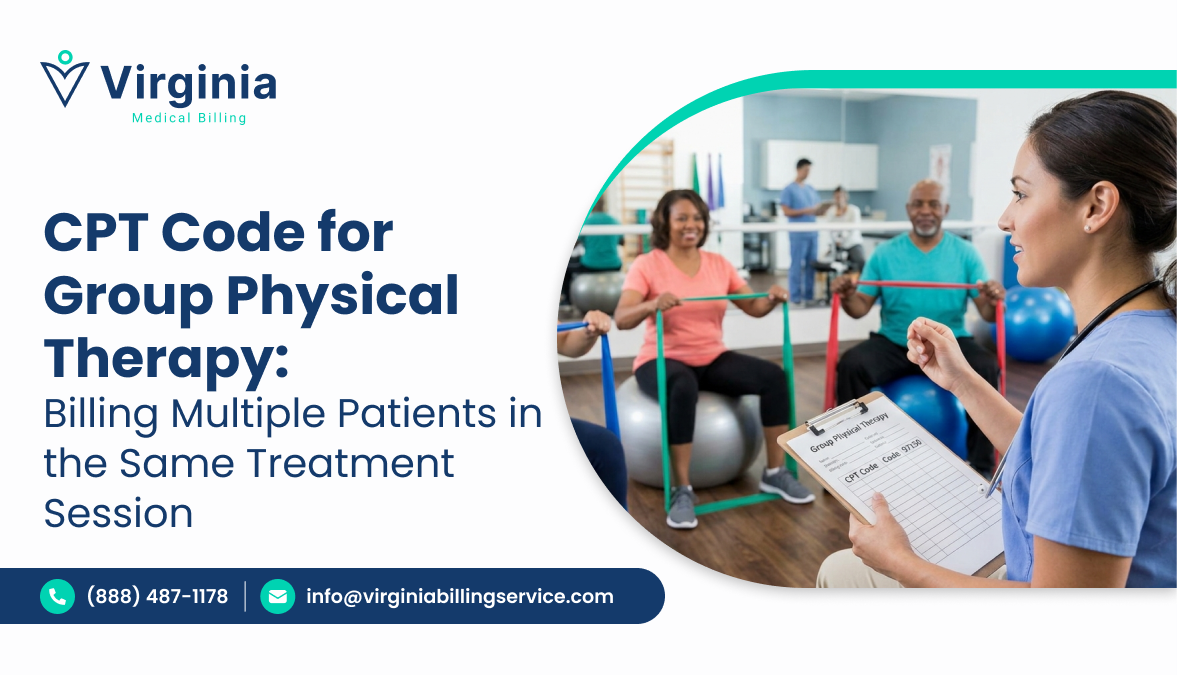

Physical therapy practices often treat more than one patient during the same time period. A therapist may move between patients, provide instructions, monitor exercises, and make individual adjustments while managing a shared treatment environment. Although this workflow is common, billing the session correctly requires a clear distinction between group physical therapy and individual therapy.
Group physical therapy is reported under CPT code 97150. This code refers to therapeutic procedure(s) provided to a group of two or more individuals, according to CMS. “Patients may engage in the same activity or different activities but the therapist renders the service simultaneously to each patient,” says CMS.
What practices face is not necessarily being familiar with the code. Instead, the billing department must decide if the service is indeed group therapy, properly record the service, and bill the claim for each individual patient.
Find out if you can bill for CPT 97150 while treating more than 1 patient in a massage and what you should be writing in your notes to justify billing, plus common billings for 97150 that could get you into trouble.
What Is the CPT Code for Group Physical Therapy?
CPT 97150 is used for therapeutic procedure(s), group, involving two or more individuals. This CPT code is different from many individual physical therapy procedures in that the therapist’s attention must be spread out over members of the group and not necessarily pointed towards one patient at all times.
An example is a PT working with 3 patients, in the same treatment area. The patients may be performing various activities that are part of their plans of care. The therapist communicates with the three patients as a whole, provides verbal feedback, watches, and quickly corrects.
That situation can qualify as group therapy when the service meets the applicable payer’s requirements.
CMS specifically describes group therapy as treatment provided simultaneously to two or more patients. The patients do not have to perform identical activities.
This is important for physical therapy practices because group physical therapy coding should be based on how the therapist actually performed the service.
When Does a Multi-Patient Session Become Group Therapy?
Simply having several patients in the same room does not automatically answer the coding question. The nature of the therapist’s interaction with each patient is important.
A group session generally involves:
- Two or more patients receiving therapy simultaneously
- A therapist who is actively involved with the group
- Shared treatment time rather than continuous one-on-one attention
- Individualized treatment based on each patient’s plan of care
- Documentation supporting the therapeutic purpose of the session
CMS guidance states that the therapist may divide attention among patients and provide brief, intermittent personal contact. In one CMS example, a therapist alternates between two patients, providing assistance and verbal cues without tracking continuous one-on-one episodes. In that situation, one unit of 97150 is reported for each patient.
This makes multiple patient physical therapy billing different from simply billing every patient for the same individual procedure.
97150 vs. Individual Physical Therapy Services
One of the most important parts of group physical therapy coding is knowing when the treatment should remain an individual service.
Common individual physical therapy codes include:
- 97110 – Therapeutic exercises
- 97112 – Neuromuscular reeducation
- 97116 – Gait training
- 97140 – Manual therapy techniques
- 97530 – Therapeutic activities
They generally provide codes for each specific therapy procedure and there are documentation and timing requirements for them.
For example, CMS offers the situation of three patients receiving identifiable one-on-one periods of therapeutic exercise. While all three patients are being treated during the same overall session, the therapist records the direct treatment time of each patient. CMS states that 97110 may be billed when the service was provided as identifiable one-on-one treatment.
Providers should understand individual vs. group physical therapy billing requirements before selecting CPT 97150 or an individual therapy code. CMS provides specific billing scenarios explaining when group therapy applies and how it differs from direct one-on-one treatment.
The key question is therefore not simply:
“Were multiple patients treated at the same time?”
Instead, ask:
“How was the therapist’s time and attention actually delivered to each patient?”
That distinction can prevent inappropriate use of 97150.
Group Therapy or Individual Treatment?
The treatment model—not simply the number of patients in the room—drives the coding decision.
Therapist divides attention among two or more patients.
✓ Shared therapist attention
✓ Individual goals remain relevant
Therapist provides identifiable one-on-one treatment.
✓ Procedure-specific coding
✓ Applicable timing requirements
Remember:
Several patients in one room does not automatically make the service group therapy.
How to Bill Multiple Patients in One Treatment Session
That is the reason code 97150 is billable when CPT 97150 is on a claim that is billed per member in the group and not one line per group.
For example, if a service requires a secondary service for each of four patients, the patient’s records must show the secondary service(s) for all four patients and the final claim should contain a secondary service for each of the four patients.
CMS states that providers must submit a report of 97150 individually for each group member.
But don’t get too excited, this is not an open invitation to document the same four encounters. Each patient has an indication, care plan, and chart.
A strong physical therapy billing workflow therefore connects:
Patient → diagnosis → plan of care → treatment → documentation → CPT code → claim
Keeping those elements aligned reduces the risk of coding inconsistencies.
A Practical Example of Group Therapy Billing
Consider a physical therapist working with three patients during a 30-minute shared session.
- Patient A is working on balance activities.
- Patient B is completing therapeutic movement exercises.
- Patient C is practicing functional mobility.
- The therapist travels between the patients, gives spoken instructions, observes performance and makes occasional adjustments.
- The therapist has never had identifiable one-to-one treatment periods.
CPT 97150 would be appropriate for this type of scenario if the service is reimbursed by the appropriate payor and the documentation supports the service being provided as a group.
The fact that patients are doing different exercises does not automatically prevent group billing. CMS specifically states that patients receiving group therapy may or may not be performing the same activities.
The documentation should make the treatment model clear instead of leaving the payer to determine what occurred from a generic statement such as “group therapy provided.”
Documentation Requirements for Group Physical Therapy
Proper record keeping is the best defense against billing issues.
A group therapy note should be able to succinctly describe what happened during the encounter and justify the medical necessity of the service.
Depending on payer requirements and the circumstances of treatment, documentation should address:
Patient-Specific Treatment Goals
Additionally, the note should always make a link between the session and the patient-centered plan of care. Personal goals for the patient need to be tackled despite them being seen in a group.
Treatment Activities
Note the therapy or activity in which the patient participated. Avoid using vague terms that leave out what the treatment consisted of.
Group Setting
The record should state that the patient attended a group therapy session with at least one other person.
Therapist Involvement
Note whether the therapist’s role was documented such as instructions, supervision, assistance, modifications or other clinical notes.
Functional Purpose
The treatment should be related to the patient’s functional limitations and to the therapy goals.
Build a Defensible 97150 Note
A clear record connects the group encounter to the patient’s clinical needs.
Group treatment documentation for 97150 will also be documented following CMS instructions: Group treatment technique, Purpose of group treatment technique, Group setting (including frequency, duration), and the number of persons in the group and goals for the group treatment.
A couple of commercial payers may additionally demand pre-authorization or documentation just before the visit.
What Should Physical Therapy Practices Avoid?
Several billing habits can create problems when multiple patients are treated together.
Billing 97150 Simply Because Patients Share a Room
The physical presence of several patients does not automatically make a service group therapy. The actual treatment method matters.
Using 97150 Without Individualized Documentation
A group session can still involve individualized goals and clinical needs. A generic note copied across several patients can weaken the claim.
Treating 97150 Like an Individual Timed Code
The billing method for group therapy is more than just adding individual minutes. Providers need to follow the published guidelines on the CPT and by payers, not make up the units based on speculation.
Ignoring Payer-Specific Requirements
Medicare, Medicaid, and commercial payers in your state for additional billing rules, authorizations, modifiers, and documentation requirements. This need to be confirmed before you rely on a specific billing procedure.
Failing to Review the Entire Claim
If the related diagnosis, authorization, provider, documentation and/or payer is incorrect, even if your CPT code is correct, you could be denied.
For this reason, physical therapy claims management is much more than code selection.
How Insurance Verification Fits into Group Therapy Billing
Prior to initiating therapy, practices should verify if the patient’s insurance will cover the planned therapy and if prior authorization or referrals are needed.
Eligibility verification can identify issues such as:
- Inactive coverage
- Benefit limitations
- Therapy visit limits
- Referral requirements
- Prior authorization requirements
- Network restrictions
- Payer-specific documentation rules
Practices should also review prior authorization requirements before treatment when the payer requires advance approval.
This could be especially helpful for practices that serve patients with many different insurance coverage.
Before providing group treatment, practices should verify that the planned services meet the payer’s coverage requirements, including medically necessary outpatient physical therapy services under Medicare.
For Virginia practices seeking a more efficient process, some billing services include eligibility and pre-authorization, along with charge entry, claims submission and follow-up, all within a single workflow. Virginia Medical Billing provides eligibility and pre-authorization information within its overall billing process.
Common Claim Problems With Group Physical Therapy
Even when the therapist provides appropriate care, a claim can encounter problems because the billing process does not accurately represent the encounter.
Common issues include:
- Incorrect CPT code selection
- Insufficient group therapy documentation
- Missing treatment goals
- Inconsistent patient records
- Incorrect units
- Missing authorization
- Eligibility problems
- Payer-specific billing errors
- Incomplete claim information
- Failure to respond to a denial within the payer’s timeframe
Accurate CPT coding and claim accuracy are equally important across other specialty billing workflows, particularly when documentation, payer requirements, and claim details must remain consistent.
Claims can go through more extensive coding and claim-accuracy rules via the VB file by reading Virginia Medical Billing’s Precocious Billing Made Simple: CPT Codes, Age Rules, and Claim Accuracy article on how selecting and documenting the correct CPTs, verification, and getting the authorization will affect your claim accuracy.
Where Denial Management Becomes Important
A rejected group claim should not just be appealed with no real reason for the claim rejection.
Let’s say the payer challenges 97150 – the team who is responsible for billing should be pulling this and reviewing:
- The original clinical documentation
- The treatment setting
- The number of patients in the group
- The therapist’s involvement
- The CPT code submitted
- Authorization and eligibility
- Payer-specific coverage rules
- Any explanation of benefits or denial code
This provides information to determine if the claim needs to be edited, more supporting documentation, or to appeal.
Focus on root causes denials management services is effective when you target the source of the problem, instead of addressing a denial as an isolated occurrence. As Virginia Medical Billing defines it, denial analysis, claims correction and appeals are part of its denial management.
Supporting Physical Therapy Billing With a Strong RCM Workflow
Group therapy claims are just one aspect of the revenue cycle for physical therapy practices. It starts before a patient has the appointment, and goes until the payer processes the claim.
A structured workflow may include:
- Eligibility: Confirm coverage and therapy benefits.
- Authorization: Determine whether prior approval is required.
- Documentation: Record the patient’s condition, goals, treatment, and therapist involvement.
- Coding: Select the CPT code that accurately represents the service.
- Charge Entry: Enter the service and supporting claim information accurately.
- Claim Scrubbing: Review the claim for missing or inconsistent information.
- Submission: Send the claim according to payer requirements.
- Follow-Up: Monitor unpaid or pending claims.
- Denial Resolution: Correct or appeal claims when appropriate.
The holistic method is especially beneficial for rehab clinics that have a large number of repeat visits.
Another option you might look at is medical coding services in case your in-house coding department is struggling with CPT choice, documentation validation and coding. Virginia Medical Billing note that its team does CPT, ICD-10 and HCPCS coding as part of its billing solutions.
Which Virginia Specialties Can Benefit From Better Therapy Billing?
Groups that treat musculoskeletal or functional problems of the body in other specialties may also have interest in a more valuable billing process, but physical therapy is the primary field for these types of groups.
Specialty orthopedic practices are capable of providing managed and coordinated rehabilitation following a fracture, injury, surgery or joint condition. Orthopedics is a service specialty Virginia Medical Billing provides for practices throughout Virginia.
Specialty orthopedic practices can also benefit from orthopedic billing services when rehabilitation follows an injury, fracture, surgery, or joint condition.
Group treatment models may also be employed for behavioral health practices, with different CPT codes and payer needs. Virginia Medical Billing’s mental health billing services offer billing support for behavioral health practices in coding, eligibility, authorization, claims, and denials.
The important thing is that the billing is supposed to be focused on the service that is provided, not an odd coding scheme.
When Outsourced Physical Therapy Billing Services Make Sense
When your practice grows, it can be difficult to manage every claim internally. While your clinicians are providing care, your front desk is checking payer eligibility, coding and billing the claim, AR chasing and communicating with the payers.
Outsourced physical therapy billing services can provide support across these functions.
A billing partner may help with:
- CPT and ICD-10 coding
- Charge entry
- Insurance verification
- Authorization checks
- Claim submission
- Claim tracking
- A/R follow-up
- Denial management
- Payment posting
- Billing reports
For practices that frequently treat multiple patients in shared sessions, having experienced PT billing services can also provide another layer of review before claims reach the payer.
The goal is not simply to submit more claims. It is to make sure the services documented in the medical record are accurately translated into claims and followed through to payment.
A Quick Pre-Submission Checklist for 97150
Before submitting a claim for group physical therapy, the billing team can ask:
- Did two or more patients receive treatment simultaneously?
- Does the service qualify as group therapy under the applicable payer policy?
- Is 97150 supported by the actual treatment provided?
- Is the patient’s individualized plan of care reflected in the documentation?
- Is the group size documented when required?
- Are treatment techniques and functional goals documented?
- Has eligibility been verified?
- Was required authorization obtained?
- Does the diagnosis support the medical necessity of therapy?
- Are the claim details consistent with the clinical record?
If the answer to each applicable question is yes, the claim has a stronger foundation for processing.
Final Takeaway
97150 CPT code is Group physical therapy is used for therapeutic procedures on a group of two or more people. But how to bill is not as obvious as identifying the code.
The practice needs to be clear on exactly what treatment the therapist provided to the patient, be able to separate group from specific and identifiable one-on-one service, document individualized clinical rationale, ensure payer-specific requirements, and bill each individual patient.
Treating more than one patient in a single encounter To ensure it’s taking the time to properly bill for each patient, the billing staff should concentrate on billing for the service, not for splitting the time between the patients. CMS guidance states it is appropriate to have different activities for each patient, with the therapist dividing attention between the members of a group.
For Virginia rehab and orthopedic practices, a consistent workflow covering documentation, physical therapy coding and billing services, eligibility verification, claim submission, and denial follow-up can help reduce avoidable payment issues. Practices looking for broader revenue-cycle support can explore top medical billing services in Virginia to bring coding, claims, A/R, and denial management into one streamlined process.
If you require an extended revenue-cycle solution for your practice, take a look at medical billing services in Virginia that will bring coding, claims, A/R, and denial management into a single process.
Frequently Asked Questions
What is the CPT code for group physical therapy?
CPT 97150 is used for therapeutic procedure(s), group, involving two or more individuals. The service must meet the applicable payer’s requirements for group therapy.
How many patients are required for CPT 97150?
Group therapy involves two or more patients. CMS states that 97150 is reported for each member of the group when the service qualifies as group therapy.
Can patients perform different exercises during group physical therapy?
Yes. CMS guidance indicates that patients receiving group therapy may or may not be performing the same activities. The therapist can provide individualized assistance while dividing attention among group members.
Is CPT 97150 the same as individual physical therapy billing?
No. Group therapy and individual therapy represent different treatment models. Individual services may use codes such as 97110, 97112, 97116, 97140, or 97530 when the documented service meets the requirements for those codes.
Can outsourced billing help with group physical therapy claims?
Yes. Physical therapy medical billing services can assist with coding, documentation review, eligibility, authorization, claim submission, denial management, and A/R follow-up. Practices should still ensure that clinical documentation accurately reflects the care provided.