
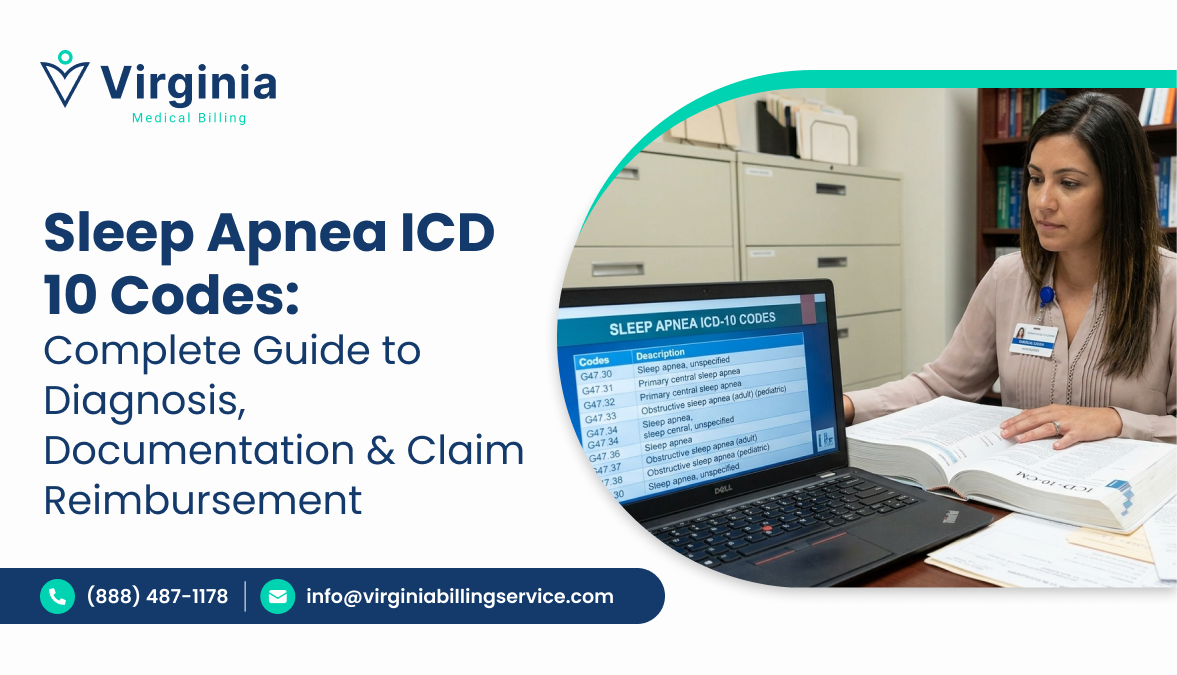

Sleep apnea is a sleep-related breathing disorder that can affect a patient’s breathing pattern, oxygen levels, sleep quality, and overall health. For healthcare providers, selecting the correct sleep apnea ICD 10 code requires more than identifying a history of snoring or interrupted sleep. Accurate coding depends on the provider’s documented diagnosis, the specific type of sleep apnea, and the applicable ICD-10-CM guidelines.
Medical necessity difficulties, altered claims, delayed payments and unreasonable denials can be triggered by bad coding practices of medical coders and billing personnel. This is a specific problem for pulmonologists and sleep physicians ordering or interpreting sleep investigations.
This article discusses popular codes for sleep apnea diagnosis, charting and documentation requirements, selecting the proper code and notes practical coding and billing problems. The article will also explain how solid revenue cycle practices and accurate medical coding services can help Virginia practices ensure smoother claim submission.
What Is Sleep Apnea and Why Does Accurate ICD-10 Coding Matter?
Sleep apnea is happened when you cannot breathe during a sleep. Apnea is the medical term for the pausing or stopping your breathing while a sleep and occurs when your airway either partially or totally blocked or your brain is not sending the right signals to a breathe.
Typical characteristics of apneas: loud snoring, suspected apneas, excessive daytime sleepiness, morning headache, impaired concentration. But anyone who exhibits the symptoms cannot be diagnosed for coding purposes.
The provider’s physical exam and test results will help determine the right sleep apnea ICD 10 code. Obstructive sleep apnea and primary central sleep apnea are two separate coding categories and using a generic code when a more specific diagnosis is recorded may impair coding accuracy.
Accurate coding matters because it helps:
- Represent the provider’s diagnosis clearly on insurance claims.
- Support medical necessity for relevant services and equipment.
- Reduce discrepancies between clinical documentation and claim data.
- Improve communication between providers, coders, and payers.
- Support appropriate reimbursement and claim follow-up.
Proper coding for a physicians that provide the care for difficult respiratory conditions must be an implemented into overall medical billing services process that encompasses verification of the eligibility, audit of charges, clean claim filing and also payment reconciliation.
Sleep Apnea ICD 10 Codes: Common Diagnosis Codes
Essential ICD-10 Coding Reference for Sleep Breathing Disorders
Assigned when physical upper airway blockages interrupt breathing. Requires diagnostic testing documentation prior to claim submission.
Used when sleep breathing pauses stem from neurological signaling failures rather than physical airway collapse.
Reserved solely for temporary reporting when clinical records confirm apnea but lack specific diagnostic differentiation.
Applicable when central sleep apnea is secondary to underlying systemic or medical conditions classified elsewhere.
Sleep apnea ICD-10-CM code is G47.3. The particular code in this category depends on the type of disorder documented in the medical record.
The most popular codes are summarized in the table below. Always refer to the full code descriptor and any appropriate instructional notes in the ICD-10-CM code set for the date of service.
| ICD-10-CM code | Description |
| G47.30 | Sleep apnea, unspecified |
| G47.31 | Primary central sleep apnea |
| G47.32 | High altitude periodic breathing |
| G47.33 | Obstructive sleep apnea (adult) (pediatric) |
| G47.34 | Idiopathic sleep-related nonobstructive alveolar hypoventilation |
| G47.35 | Congenital central alveolar hypoventilation syndrome |
| G47.36 | Sleep-related hypoventilation in conditions classified elsewhere |
| G47.37 | Central sleep apnea in conditions classified elsewhere |
| G47.39 | Other sleep apnea |
These codes are not interchangeable diagnoses. For example, G47.33 is for obstructive sleep apnea while G47.31 is for primary central sleep apnea. G47.30 is used for sleep apnea not otherwise stated in the documentation and is not a default code for every patient with sleep-related breathing problems.
The code family also comprises conditions of hypoventilation or unique breathing patterns. These must be recorded only if supported by the provider’s diagnosis and the necessary coding instructions.
FY 2027 Coders must refer to a official ICD-10-CM files and the guidelines from Centers for Medicare & Medicaid Services (CMS) for October 1, 2026 through a September 30, 2027.
Obstructive Sleep Apnea ICD 10 Code: G47.33
Obstructive sleep apnoea (OSA) is also a disorder characterized by a recurrent blockage or the constriction of upper airway during sleep Such interruptions may be limit airflow and interfere with the normal sleep behavior. OSA may occur in both adults and children and diagnosis should be based on clinical assessment of the clinician.
Obstructive sleep apnea is coded G47.33 in the ICD 10.
This is a typical code used when provider documents an obstructive sleep apnea. However, the coders could not make this diagnosis simply on the patient snores, reports day time weariness, or has a positive screening questionnaire. The diagnosis should be supported by a medical documentation.
Documentation Standard Checklist
Required medical record criteria to justify Obstructive Sleep Apnea (G47.33)
Explicit Provider Note: Unambiguous diagnosis statement signed by an authorized physician.
Polysomnography Findings: Objective sleep study data verifying AHI/RDI indices and severity levels.
Clinical Symptom Profile: Documented presence of sleep disturbance, excessive somnolence, or gasping.
Prescribed Care Plan: Documented orders for PAP devices, oral appliances, or surgical evaluations.
What documentation supports G47.33?
Before assigning G47.33, review the available clinical documentation for:
- The provider’s explicit diagnosis of obstructive sleep apnea.
- Relevant sleep study findings, when available and applicable.
- Clinical assessment and interpretation of diagnostic results.
- Treatment plans, such as positive airway pressure therapy, when prescribed.
- Relevant comorbidities and other conditions that may affect care.
Although a sleep study report can be important diagnostic evidence, coders should adhere to proper documentation and payer standards and should not independently interpret test results to render a diagnosis.
Billing example: A patient is seen by a pulmonologist for follow up after a sleep study. The diagnosis of obstructive sleep apnea is recorded. G47.33 might help support the diagnosis aspect of the claim if the service is fully recorded and fits the payer’s standards. The services actually provided must still be billed using the proper procedure codes.
Virginia Medical Billing can also offer pulmonology billing aid to clinics for a better understanding of a specialty-focused revenue cycle in respiratory treatment.
Central Sleep Apnea ICD 10: Understanding G47.31 and Related Codes
Obstructive sleep apnea is not the same as central sleep apnea. The etiology of central sleep apnea is not mainly an obstructed upper airway. But it is a disturbance of the impulses that control breathing during sleep.
This is important since the code needs to match the defined type of condition.
G47.31: Primary Central Sleep Apnea
Use G47.31 when the provider has documented main central sleep apnea and the diagnosis meets the code defining criteria.
Coders need to check the clinical assessment and any pertinent sleep study evidence. It should not be prescribed routinely to all patients who have a stop in breathing during sleep.
G47.37: Central Sleep Apnea in Conditions Classified Elsewhere
G47.37 Central sleep apnea in situations categorized elsewhere. This number is used when the documented central sleep apnea is due to another defined disorder, with corresponding ICD-10-CM instructions.
Review the underlying diagnosis and any instructions related to any further codes. The coding sequence to be used will rely on the conditions reported and the official rules.
G47.32: High Altitude Periodic Breathing
G47.32 Breathing periodically in high altitude This is not a universal replacement for main central sleep apnea or obstructive sleep apnea. Only do this if the diagnosis you have been given calls for this exact breathing pattern.
G47.39: Other Sleep Apnea
Other sleep apnea G47.3 It can be utilized when the provider states a type of sleep apnea that is included in this group but does not fit a more precise type.
Do not default to G47.39 due to uncertainty of the diagnosis on the part of the coder. If the record is ambiguous, request clarification, do not assume the code.
Sleep Apnea, Unspecified ICD 10: When Is G47.30 Appropriate?
The ICD 10 code for sleep apnea undetermined is G47.30.
This code is used when sleep apnea is documented, but the documentation does not specify a more specific kind. May be appropriate for undefined recorded provider diagnosis.
The clinician may assess for sleep apnea but may not identify whether it is obstructive, central or any other type. If the code documentation does not provide for a more precise diagnosis, G47.30 may be used.
However, coders should not assign G47.30 by default if the provider has already documented a specific form of sleep apnoea elsewhere in the record. Before finalizing, review pertinent notes, diagnostic findings, and provider assessments.
Some extra clarification may impact the selection of code and may be resolved by a compliant provider inquiry.
The objective is not to find the most thorough code at all cost. The intent is to choose the most exact code the documentation and official coding guidelines allow.
How to Choose the Correct Sleep Apnea Diagnosis Code
The correct selection of sleep apnea ICD 10 code starts with the diagnosis, not the patient’s symptoms or the anticipated reimbursement.
Use the following approach to assist provide coding consistency to a sleep medicine or pulmonary practice.
- Identify diagnosis of the provider. Review examination and pertinent clinical notes to establish if the clinician documented obstructive, central, nonspecific, or other sleep apnea.
- Examine supporting documentation. Review applicable sleep study records and diagnostic results where accessible and applicable for the service.
- Review the ICD-10-CM Index and Tabular List. Check the code description, inclusions, exclusions and any instructions for extra coding.
- Evaluate related conditions. If there is an underlying condition on the record, see if the code family demands more codes or a certain order of codes.
- Verify payer criteria. Check the coverage policies, medical necessity requirements, authorization requirements and documentation standards for the service you are billing.
- Validate the claim before to submit. Ensure the diagnosis is consistent with the record and properly linked to the service reported.
Review the official ICD-10-CM coding guidelines to support accurate diagnosis code selection and ensure compliance with applicable coding requirements.
For current coding decisions, please use an authoritative list of CMS ICD-10 codes. The FY 2027 ICD-10-CM files are effective for dates of service on or after October 1, 2026 through September 30, 2027.
Sleep Apnea Documentation Requirements for Accurate Coding
Bad or inconsistent documentation cannot be overcome, no matter how good the right code is. The supporting diagnosis must be documented in the medical record.
Clear documentation and accurate code selection are important across specialties, although each diagnosis and service has its own coding rules. Reviewing other examples of medical coding and documentation requirements can help illustrate why claims must be supported by the appropriate records.
Important documentation elements may include:
- Diagnosis statement: Clearly identify the type of sleep apnea when established.
- Clinical assessment: Document the relevant symptoms, examination findings, and clinical reasoning.
- Diagnostic evidence: Include or reference relevant sleep study results when appropriate.
- Treatment plan: Record prescribed treatment, follow-up, and management decisions relevant to the encounter.
- Associated conditions: Document underlying diseases when they are clinically relevant and established by the provider.
- Medical necessity: Explain why the service, test, equipment, or follow-up care is necessary.
- Date and provider details: Maintain complete encounter information and the required authentication.
Understanding sleep apnea diagnostic procedures can help providers and billing teams recognize the role of clinical evaluations and sleep studies in supporting documented diagnoses.
Documentation needs vary by service, payer and setting. For instance, a diagnostic test, a follow-up appointment, and a claim for positive airway pressure equipment may each have different coverage and documentation criteria.
That’s why sleep apnea diagnosis code shouldn’t be simply taken as confirmation that all connected services are covered. The billing team needs to examine the service provided and the policy that is applicable.
Sleep Apnea Medical Billing and Insurance Claim Guidelines
Sleep apnea claims require proper diagnosis coding. However, claims for this condition usually involve additional services such as office visits, interpreting tests, equipment, and services after the diagnosis has been confirmed. All of these services must be coded and billed correctly.
Verify Insurance Eligibility and Benefits
Confirm that the patient has benefits that are in force before booking an appointment. You will also need to determine if a referral, authorization or additional paperwork is needed for the service.
It is important to know who is responsible for what if a dispute occurs or a claim is denied. Never assume that what was covered for one service will be covered for another.
Review Prior Authorization Requirements
Depending on the payer, certain sleep studies or services, or durable medical equipment may require prior authorization. Check the coverage of the patient’s plan for the service requested.
If prior-authorization is needed, but was not received, note this on the claim and follow the payer’s steps for getting the authorization. In the case when a service is rendered, but the authorization was not secured, whether it is too late to get retrospective authorization in medical billing depends on the payer’s policies. One valuable resource is this guide to retrospective authorization.
Match Diagnosis Codes to the Services Billed
The diagnosis that is claimed should support the services provided. Ensure that coders understand which procedure code is billed, the link between the diagnosis, documentation, and the payers’ policies.
Though G47.33 is the code for obstructive sleep apnea, that condition may not be an indication for study, equipment, or a distinct therapy. The service to be billed is to be checked against the coverage and medical necessity criteria.
Submit Clean Claims and Track Payments
Before submits: Check patient, insurance, and providers’ data, diagnosis, procedures, codes, authorization, and attachments to the claims. After submitting, track the claims to make sure that they are processed without issues. Check remittance advice for any denials, adjustments, or requests for additional information.
To make sure that claims are handled smooth, ask practices considering outsourcing their billing to Virginia Medical Billing to learn more about medical coding companies in Virginia and denial management companies in Virginia.
Common Sleep Apnea ICD-10 Coding Errors
Even when a provider properly documents the diagnosis, several errors can occur during the coding and billing stage. The following tips may help to prevent them.
Using an Unspecified Code When a Specific Diagnosis Is Documented
The coder should not assign G47.30 when there is a more specific category for the diagnosis documented by the provider.
How to prevent the mistake: Review the provider’s evaluation and relevant documentation.
Confusing Obstructive and Central Sleep Apnea
The diagnosis codes for obstructive and central sleep apnea are different. This mistake can occur when the provider documents either of these conditions.
How to prevent the mistake: Make sure the diagnosis documented by the provider matches the code.
Reporting a Diagnosis Without Adequate Support
Having multiple signs and symptoms doesn’t necessarily mean that a diagnosis of sleep apnea is present.
How to prevent from making mistake: Ensure that diagnosis reported by coders is consistent with the provider’s documentation. If documentation is missing in the record, request clarifying information.
Overlooking Authorization and Coverage Requirements
Sometimes a service that is indicated for the patient’s diagnosis is not covered due to the lack of proper authorization.
How to prevent the mistake: Whenever possible, verify prior-authorization requirements for the coverage of the diagnosis-related service and keep the relevant documents.
Failing to Review Denial Reasons
Claims can be denied for various reasons. The same cause might affect multiple claims.
How to prevent the mistake: Group denials according to their reason and respond accordingly. Check if the same error occurs several times.
Workflow Strategy: Preventing Sleep Apnea Claim Denials
Key operational checkpoints for pulmonary and sleep medicine billing teams
Confirm coverage policies for sleep studies (CPT 95810/95811) and DME items prior to scheduling visits.
Review complete notes to replace default code G47.30 with specific indicators (G47.33 vs. G47.31) whenever supported.
Verify direct medical necessity links between diagnostic findings and corresponding E/M or procedure lines.
Audit demographic accuracy, NPI markers, modifier applications, and authorization attachments prior to filing.
Categorize remittance advice adjustments promptly to resolve root-cause coding bottlenecks.
How Medical Billing Services Help Sleep Clinics Improve Reimbursement
Medical billing services that process sleep apnea claims can help clinics to increase reimbursements. Sleep medicine practices have to handle a variety of matters in addition to the medical services which they provide to the patients. Appropriate diagnosis, correct coding of the claims, submitting them in a timely manner and managing denied claims are all a part of the successful revenue cycle.
Outsourcing medical billing can help practices to maintain order in their financial operations and avoid mistakes.
Accurate Medical Coding
Medical coding assistance to ensure the diagnosis correlates with the documentation as well as the application of correct ICD-10-CM standards. Assistance can also flag up where the practice is not applying coding standards consistently.
Efficient Claim Submission
Medical billing includes various steps that must be taken before submitting the clean claim to the insurance companies for processing and reimbursement to the patient. This is done to prevent claim rejections.
Denial Prevention and Follow-Up
At the point when a claim is denied or reimbursed incorrectly, coders and billers can detect the reason and the action to be taken. They can resubmit the corrected claim and appealed it. The process includes retrieving the denied claims.
Revenue Cycle Management
Revenue cycle management (RCM) covers the whole billing cycle of a patient from registration to payment. Knowing all its parts, front-end and back-end, can help medical practices realize the best ways to recover their lost revenue.
Firms that provide medical billing support to Virginia practices can learn more about medical billing, coding, and denial management services in Virginia at Virginia Medical Billing.
Optimizing Pulmonary & Sleep Medicine Revenue Cycles
Managing sleep apnea billing requires balancing detailed clinical documentation with stringent payer rules. Specialized medical billing services empower Virginia healthcare practices to maintain consistent cash flow while minimizing administrative workload.
Certified Coding Accuracy
Ensure accurate ICD-10 and CPT mapping backed by regular compliance audits.
Accelerated Claim Filing
Clean claim submissions drastically lower upfront rejection and processing turnaround times.
Active Denial Management
Dedicated follow-up specialists appeal incorrect rejections and recover lost clinical revenue.
Full Revenue Cycle Control
Transparent reporting keeps clinic directors fully informed on cash collection metrics.
Conclusion
Proper study of the ICD-10-CM criteria and an accurate diagnosis are needed for correct sleep apnoea ICD 10 coding. The right code helps ensure you get reimbursed for the services you deliver. Diagnosis code for obstructive sleep apnoea is G47.33. The code G47.31 describes the primary central type of sleep apnea, and G47.30 is used when sleep apnea is unspecified. Other ICD-10-CM codes that describe sleep-related breathing disorders should also be reviewed.
In addition to understanding sleep apnea diagnosis codes, coders and billers can benefit from ensuring that documentation supports the reported diagnosis, reviewing the payers’ requirements for claims submission, and following up on denied claims. These measures help to reduce errors during the medical billing process.
Healthcare practices looking for a leading medical billing company in Virginia can rely on Virginia Medical Billing to provide billing and coding support services that help them to meet their administrative needs.
Frequently Asked Questions About Sleep Apnea ICD 10
What is the ICD 10 code for sleep apnea?
The best code is determined by the type that is reported. G47.30 is sleeping apnea, unspecified G47.33 is obstructive sleep apnea. Other codes are used for central sleep apnea and other sleep related breathing disorders.
What is the obstructive sleep apnea ICD 10 code?
G47.33 – Obstructive sleep apnea (adult and pediatric) The documentation of the diagnosis should be confirmed by the provider as well as the claim should be fulfilling the requirements of the payers.
What is the ICD 10 code for central sleep apnea?
The ICD-10-CM code for primary central sleep apnea is G47.31. The code for central sleep apnea due to conditions classifiable to other categories is G47.37.
When should coders use G47.30?
G47.30 should be used when sleep apnea is present, but the type is unspecified. This code should not be reported when a more specific code is applicable.
Can a sleep apnea diagnosis guarantee insurance reimbursement?
Having a diagnosis is only one part of the medical billing process. A claim can be denied even when the diagnosis is correct. A sleep apnea diagnosis does not ensure reimbursement since each case depends on the coverage, medical necessity, and other factors such as authorization, procedure coding, provider’s eligibility, and others.
How can sleep clinics reduce sleep apnea claim denials?
One way to help prevent sleep apnea claim denials from happening is to check the insurance coverage, authorization status, Review the diagnosis and procedure codes, review documentation for the claim, as well as how to properly follow up.