
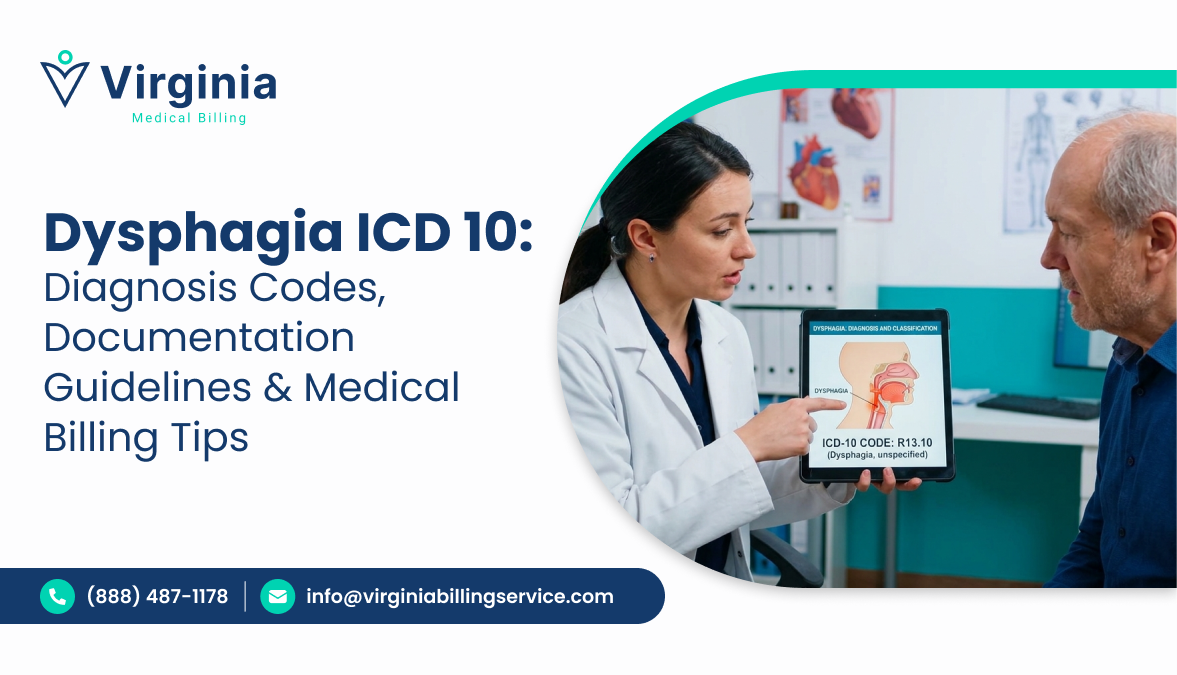

Dysphagia, or difficulty swallowing, can have adverse effects on a patient’s ability to eat and drink, as well take medications. It can relate to the neurological, anatomical, esophageal, or an age-related cause. For the doctors and other medical professionals, being able to distinguish between symptoms and an effectively determine the stage of a dysphagia is an essential for the proper treatment and for a medical coding purpose.
A proper understanding of Dysphagia (ICD 10) requires not only being familiar with the nature of the disease but also learning the mechanism of swallowing and symptoms that can help in diagnosis, as well as differentiating factors between the two. Also, they have to remember that for the code to be valid a documentation has to match it. Otherwise refused claims, denied the reimbursements and more can happen.”
Medical doctors, surgeons, speech-language pathologists and other healthcare providers should learn about code for the diagnosis of dysphagia. In this article, we make an extensive review of dysphagia coding, documentation requirements, medical necessity, and other relevant information. These may help medical billing firms to modify their claims filing and a reimbursement practices, and to prevent the rejection or denial of claims.
What Is Dysphagia and Why Does Accurate Coding Matter?
The term dysphagia refers to a swallowing disorder involving food, liquids/saliva. The most common signs associated with dysphagia are coughing when eating/drinking and/or choking on something being eaten/drunk. The most prevalent causes of dysphagia are stroke, neurological disorders, head/neck deformities and esophageal diseases. The condition often occurs due to injury or neurological damage affecting one’s ability to swallow.
The ICD-10-CM codes for swallowing disorders depend on the provider’s diagnostic and documentation. An incorrect code, which is either inappropriate or not documented by the provider, can be the source of the wrong reimbursement, no reimbursement and query.
Accurate dysphagia coding helps providers:
- Maintain accurate medical records.
- Support medical necessity for evaluations and treatment.
- Communicate the patient’s condition clearly.
- Reduce avoidable claim denials and documentation requests.
- Improve diagnosis reporting and claim accuracy.
The goal of the assignment is to report the documented condition accurately according to established coding guidelines and payer requirements.
Dysphagia can affect a person’s ability to swallow food, liquids, or saliva and may be associated with neurological conditions, stroke, or esophageal disorders. Learn more about swallowing disorders and dysphagia through MedlinePlus.
Dysphagia ICD 10 Codes: A Practical Reference for Providers
ICD-10-CM code R13, Aphagia and dysphagia. Some codes in this group describe the stage or type of dysphagia and are a part of the billing and clinical recording process. Digestion and swallowing: The following codes are associated with digestion and swallowing:
| ICD-10-CM code | Official description | Coding consideration |
| R13.10 | Dysphagia, unspecified | Use when the documentation does not establish a more specific type. |
| R13.11 | Dysphagia, oral phase | Identifies difficulty during the oral phase of swallowing. |
| R13.12 | Dysphagia, oropharyngeal phase | Identifies difficulty involving the oral and pharyngeal transition. |
| R13.13 | Dysphagia, pharyngeal phase | Identifies difficulty during the pharyngeal phase. |
| R13.14 | Dysphagia, pharyngoesophageal phase | Identifies difficulty involving the pharyngoesophageal phase. |
| R13.19 | Other dysphagia | Includes certain documented types, such as cervical or neurogenic dysphagia, when applicable. |
These codes should be chosen according to the provider’s records and the present ICD-10-CM Alphabetic Index, Tabular List, and instructions. The AAPC’s ICD-10-CM dysphagia code reference gives you an idea of what the category entails and the language used for coding it.
R13.10: Dysphagia, Unspecified
R13.10: Care provider describes a problem with swallowing but does not specify the swallow phase or identify the dysphagia (a note of dysphagia indicates a condition but not oral, pharyngeal, or esophageal phase).
This code should not be used as a default code for any dysphagia-related issues. If a more specific workup dictates a different category, an appropriate assignment should be made.
If the clinical note is not sufficient, the provider may need to be queried to find out what diagnosis is supported by their observations.
R13.11 and R13.12: Oral and Oropharyngeal Dysphagia
R13.11 Dysphagia, oral phase, where the condition identified is related to the oral stage of swallowing
R13.12 Oropharyngeal dysphagia, involving the oral and pharyngeal transition. These distinctions may be particularly critical for speech language pathologists and the rehabilitation professionals involved in the assessment of swallowing function.
For example, documentation which identifies the impairment of oral bolus control can be utilized to evaluate the diagnosis of the oral-phase. A documented oropharyngeal swallowing impairment would support R13.12 instead, given the clinical record established the diagnosis.
The selected code should relate to the provider’s assessment rather than to assumptions regarding the treatment delivered.
R13.13 and R13.14: Pharyngeal and Pharyngoesophageal Dysphagia
R13.13 is related to dysphagia of the pharyngeal stage while R13.14 is the code for dysphagia of the pharyngoesophageal phase.
This is a collective for people who are undergoing assessments or treatments for dysphagia that is associated with neurological or anatomical complications. The difference between the two is manifested by the specific swallowing stage at which the impediment occurs and that is why it is important to make a distinction between the two in order to code correctly.
The health care personnel caring for a patient with dysphagia should record the type of the swallowing dysfunction and the evaluation results. If a swallow study or swallow evaluation is performed, reports must specifically state the association of the diagnosed problem with the detected swallowing phase.
R13.19: Other Dysphagia
R13.19 also includes additional defined dysphagia within the scope of the code’s definition. Such as, the instance of neurogenic dysphagia and cervical dysphagia.
It should not be employed simply because of a sophisticated presentation. The record must support a form of dysphagia that is appropriate to the code.
Important coding note: The applicable R13 dysphagia category contains instructions related to dysphagia following cerebrovascular illness. If applicable, follow instruction of the relevant code first for the appropriate I69.- sequelae code ending in the characters supplied in the Tabular List. Psychogenic dysphagia also contains an exclusion directive with F45.8. Verify the current code set before submitting the claim.
How to Select the Correct Dysphagia Diagnosis Code
The accurate ICD-10 classification for dysphagia is often determined by a careful evaluation of the medical record. The following steps can assist providers and coders in this endeavor.
- Confirm the documented diagnosis. Ascertain whether the provider has determined dysphagia or if there is only a possible diagnosis that needs to be ruled out. A diagnosis is not established based on the reason for the referral or patient’s complaint.
- Identify the swallowing phase. Check the evaluation and assessment to ensure documentation is in support of otolaryngology, oral, pharyngeal or pharyngoesophageal dysphagia.
- Check for a specified type. If the record documents an additional type of dysphagia consider whether R13.19 is applicable. This code should not be used as an alternative to a more specific phase-specific code.
- Review related conditions and coding instructions. If dysphagia is coded as a complication of a stroke or other cerebrovascular disease, the sequence and sequel should be coded. Additional factors may also be relevant to assignment of these codes.
- Verify the code against the current code set. Read the official descriptor language, inclusion and exclusion notes, and code first notes, if present. Confirm the code is in effect for the service date.
This would help to decrease report discrepancies and enhance the quality of medical coding service for hospitals.
Dysphagia Documentation Requirements for Accurate Claims
A correct code always starts with a complete clinical record. Documentation of dysphagia may differ by context, provider and payer. However, the record should support the diagnosis and justify the service delivered.
Rehabilitation providers can also review physical therapy billing and documentation requirements to understand how treatment records, medical necessity, and payer rules affect therapy claims.
Essential Elements of Clinical Documentation
Providers should document relevant elements such as:
- The patient’s swallowing complaints and pertinent history.
- The clinical assessment and findings supporting the diagnosis.
- The affected swallowing phase or specified type, when established.
- Relevant underlying conditions and their relationship to dysphagia.
- The treatment plan, goals, and expected clinical outcomes.
- The rationale for evaluations, therapy, or follow-up services.
- The patient’s progress and response to treatment, where applicable.
The swallowing deficit should be detectable during the speech language pathologist’s assessment and the treatments attributable to the patient’s functional need. Information pertaining to diagnostic and treatment service should be documented by gastroenterologists and other physicians.
When a Provider Query May Be Necessary
The documentation that is missing, irregular or not sufficient to select a reported code might answer a question. For example, the test might state that the patient has a problem swallowing and then it does not make mention of one component of the swallow.
A suitable query should be developed with the appropriate discoverability of a main diagnosis within the clinical record, cannot ask clinicians to confirm a diagnosis only to confirm a particular code or reimbursement.
Additional documentation will assist coders in ascertaining the diagnosis without the necessity to resubmit or guess as to whether to resubmit.
Medical Necessity and Dysphagia Billing Guidelines
But remember that the allegation is not only solely about diagnosis coding. The provider must be able to establish the service which was justified, delivered and also documented.
For swallowing assessment and the dysphagia treatment: Documentation should include the clinical picture of the rationale for a service and how the service fits into a treatment plan. Some of services and/or payers may be require referrals, orders, certificates or the authorizations and plan of the care documents or progress notes.
Diagnosis-related codes, procedure-related codes, paperwork, units, and payer-specific requirements, can all be part of medical billing for speech therapy services. Not all services can be billed by paying for a diagnosis code.
Before submitting a claim, billing teams should verify:
- Whether the service is covered under the patient’s plan.
- Whether a referral, order, or authorization is required.
- Whether the documentation supports the service billed.
- Whether procedure codes, units, modifiers, and dates are accurate.
- Whether claim details comply with payer-specific submission rules.
- Whether required records are available for review or audit.
These examinations are especially critical in cases where therapy is repeated or when treatment is performed in several environments. Demands are not the same for patients enrolled on Medicare, Medicaid or a commercial insurance. It is important to analyze the rules that applies to the particular situation and not the demands of all insurers.
When required authorization is missed, providers should review the payer’s policies and understand the available options for retrospective authorization in medical billing.
Common Dysphagia Coding Errors That Can Lead to Claim Denials
If the physician renders appropriate care, denials, delays or a nonpayment should be caused by the misdiagnosis, diagnostic service inadequacy or a claim submission error.
A structured review process and professional denial management services can help billing teams identify claim issues, correct supported errors, and manage appropriate appeals.
Using an Unspecified Code When More Detail Is Available
R13.10 may be used if the specific type of dysphagia is not indicated, but if an explicit statement as to the affected stage is present, the coding team should consider using a more detailed code.
Selecting a Code Without Clinical Support
Compliance is negatively impacted when the diagnosis is supported by documentation and a specific code such as R13.11, R13.12 or any other specific code is used. Coders should not anticipate the swallowing phase from the procedure conducted, treatment exercise or isolated symptoms.
Overlooking Code Sequencing Instructions
Dysphagia due to cerebrovascular disease may have a particular sequencing to it. Not reviewing the I69.- instructions could result in a mistakenly sequenced claim.
Incomplete Medical Necessity Documentation
If the record is not supportive of medical necessity for a service or procedure, then a claim could be denied. Documentation of services performed needs to support a diagnosis to the service performed, as well as meet coverage criteria.
Missing Payer-Specific Requirements
Some payors request authorizations, referrals, evidence of plan of care or supporting records. If you don’t have any of these pieces of documentation, your claim can be denied even if the diagnosis code is right.
Such errors should be caught in a consistent pre‐submission check and fixed before submission. In case of refusal the billing team should analyses the reason of denial and correct the problem or submit the evidence or appeal to the appropriate party.
How Medical Billing Services Help Dysphagia Providers
Diagnosis coding, paperwork, authorizations, claim submission and payment follow up can be an overwhelming task to any practice. By outsourcing medical billing and coding services to a third party, a practice can free their time up to dedicate more resources into treatment.
For practices with patients with swallowing disorders, some potentially useful tools may include:
Diagnosis and claim review: review the diagnostic chosen and checking to see if a claim is supported by clinical data and also the coding instructions that apply.
Claims Submission: The required claim fields have been populated and claims have been submitted within the payer timeframes.
Denial management: Researching the denials, identifying the patterns of the errors, helping with the corrections and helping with the timely appeals.
Accounts receivable follow ups: Keep an eye on claims not paid, balances overdue and payment wait times.
Payer requirement tracking: Assisting practices monitor the specific billing rules, authorizations, and documentation that they need to be aware of.
Along with therapy billing, speech-language pathology service lines, gastrointestinal service lines, and neurology service lines and rehab service lines may have diverse demands.
Virginia Medical Billing is offering medical billing services in Virginia state by providing billing and coding, claims submission and rejection management services. Outpatient medical practices that are considering outsourcing their billing services to a third party would be better off outsourcing their billing services to Virginia Medical Billing to alleviate the pressure on the practice of satisfying the numerous demands of the report, services, and Privacy standards.
Which Providers Benefit from Better Dysphagia Coding and Billing?
Dysphagia can appear across multiple healthcare settings, making accurate coding relevant to a range of providers.
- Speech-language pathologists: Need documentation that supports swallowing assessments, therapy plans, and billed treatment services.
- Gastroenterologists: May evaluate swallowing difficulties associated with esophageal or other digestive conditions.
- Neurologists: May assess dysphagia associated with neurological disorders and cerebrovascular events.
- Rehabilitation providers: Need consistent diagnosis reporting and documentation that supports functional treatment goals.
- Hospitals and outpatient clinics: May coordinate dysphagia care across different departments and clinical teams.
Practices might consider looking into specialty-specific medical billing solutions to learn how they could be modified for their clinical service. Billing partner should be looking at the needs of each practice rather than taking a process and shoehorning it into a specialty.
Providers treating swallowing disorders can explore medical billing solutions for different specialties to find support suited to their practice’s coding, documentation, and reimbursement needs.
Practical Checklist Before Submitting a Dysphagia Claim
Use this checklist to strengthen your dysphagia billing workflow:
- Confirm the diagnosis in the provider’s signed documentation.
- Select the most appropriate supported ICD-10-CM code.
- Review relevant code-first and exclusion instructions.
- Confirm that the service is supported by medical necessity documentation.
- Check payer requirements for referrals, authorization, and supporting records.
- Verify procedure codes, units, modifiers, and other claim details.
- Submit the claim within the required timeframe.
- Track claim status and investigate denials promptly.
A consistent approach helps practices to catch problems sooner and save administrative rework. But coding accuracy must always be based on the clinical record and current government guidelines.
Final Thoughts: Improve Dysphagia Coding and Reimbursement Accuracy
Correct dysphagia ICD 10 coding is basically a matter of the physician and the billing staff correctly identifying which phases of swallowing are being reported and then selecting the appropriate diagnosis codes and sequencing recommendations. R13.10 R13.11 R13.12 R13.13 R13.14 R13.19 ICD-10-CM Each is used for a specific purpose and should be billed only in the manner that they are allowed.
Proper clinical documentation, medical necessity, payer specific claim assessments and good denial management will be required to file a complete claim. To reduce coding and billing problems and to improve the whole revenue cycle, medical clinics should take all these procedures. If your business wants to improve the current claims submission and increase revenue, it may be a good idea to resort to a professional medical billing company.
The seasoned partners in medical billing understand the requirements of the different specialties and can offer comprehensive revenue cycle solutions. So, if you want to make sure that you are submitting and collecting claims correctly, without any mistakes, then do not hesitate to call Virginia Medical Billing.
Practices looking to improve coding accuracy, streamline claims, and strengthen their revenue cycle can partner with a medical billing company in Virginia for comprehensive billing support.
Frequently Asked Questions About Dysphagia ICD 10
What is the ICD-10 code for dysphagia?
The correct code is determined by the documented type of dysphagia. R13.10 is for unspecified dysphagia, R13.11-14 specify a phase of swallowing, and R13.19 are other types of dysphagia in their code descriptor.
What is the ICD-10 code for oropharyngeal dysphagia?
R13.12 is the ICD-10-CM code for dysphagia, oropharyngeal phase. The provider’s documentation should support this diagnosis.
When should R13.10 be used?
R13.10 is indicated when dysphagia is specified but there is no documented more specific type. If the provider identifies the specific swallowing phase, this should be taken into consideration when selecting the code.
Can dysphagia be coded with an underlying neurological condition?
Yes, given the documentation and coding guidelines. Sequencing instructions exist in cerebrovascular disease-related dysphagia; the I69.- code and current Tabular List directives should be reviewed.
How can medical billing services help reduce dysphagia claim denials?
Medical billing services may examine the coding of diagnosis, check the information contained on claims, keep track of payer needs, check on delinquents, and check and research for denials. This can help reduce preventable errors although the payment and coverage are subject to the individual claim and insurance policy.